
Hearing aids: an investment to improve your quality of life!
Hearing aids: an investment to improve your quality of life!
Hearing aids are a real solution for improving the living comfort of people with hearing problems. By allowing them to hear better and fully integrate into their environment, they offer numerous benefits on a daily basis.

What are the most important factors to consider when choosing your hearing aids?
Type and level of hearing loss
The degree of hearing loss can influence the choice and size of a hearing aid. However, thanks to technological advances, it is now possible to combine power and discretion, even for more severe hearing loss!
Environment
Each hearing aid is available in several technology levels to precisely meet your needs. During your consultation, we will recommend the features best suited to your lifestyle and the environments you frequent (work, sports, leisure activities, retirement, etc.).
Discretion
For those seeking greater discretion, some hearing aids fit directly into the auditory canal, becoming almost invisible. Plenty of styles (e.g. RIC mini behind-the-ear), colors and models are also available to combine performance, comfort and aesthetics, in perfect harmony with your tastes and lifestyle.
Vision and dexterity
If you have vision or dexterity issues, the hearing care professional will recommend a model that is easier to handle and will ensure that your hearing aids’ audio settings adjust automatically based on your listening environment and amplification needs.
Budget
At Réseau Vos oreilles, we offer a variety of options to fit your budget. In addition, certain insurance providers (RAMQ, CNESST, WSIB, ACC, SSNA, PFSI) may cover the cost of hearing aids, provided you meet the eligibility criteria.
Invisible hearing aids: are they right for you?
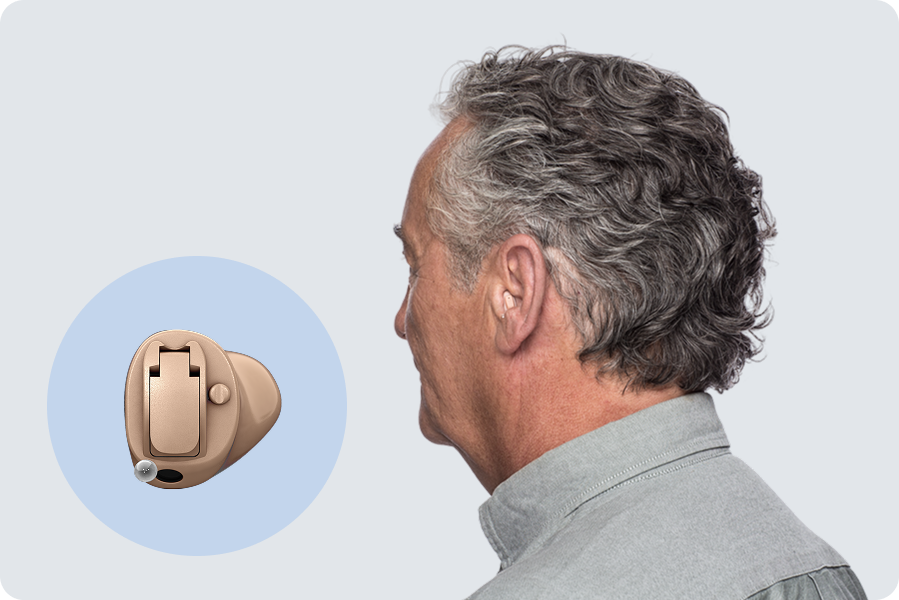
Peritympanic in-the-ear hearing aids (also known as CICs or IICs) offer a discreet, high-performance solution for improving your hearing while preserving your appearance. Designed for a subtle fit, they combine comfort and efficiency in everyday use.
Key features:
- Almost invisible : designed to fit seamlessly into the ear canal, they offer a discreet solution that’s perfectly adapted to the ear’s anatomy.
- Optimized for moderate hearing loss: If you have moderate hearing loss, behind-the-ear hearing aids are particularly effective at meeting your hearing amplification needs.
- Natural feel : their deep insertion in the auditory canal, together with ample ventilation, helps minimize any sensation of a blocked ear.
- Personalized fit: custom-made to perfectly fit the unique shape of each user’s auditory canal.
- Easy maintenance : equipped with replaceable wax filters for simple maintenance.
- Rechargeable: In-the-ear (CIC or IIC) hearing aids are now available without batteries. Simply place them on a charging base overnight, and they will be fully charged by the next morning.
Click here to learn more about invisible hearing aids
Important notice : an assessment by an audioprosthetist is required to determine which model is right for you.
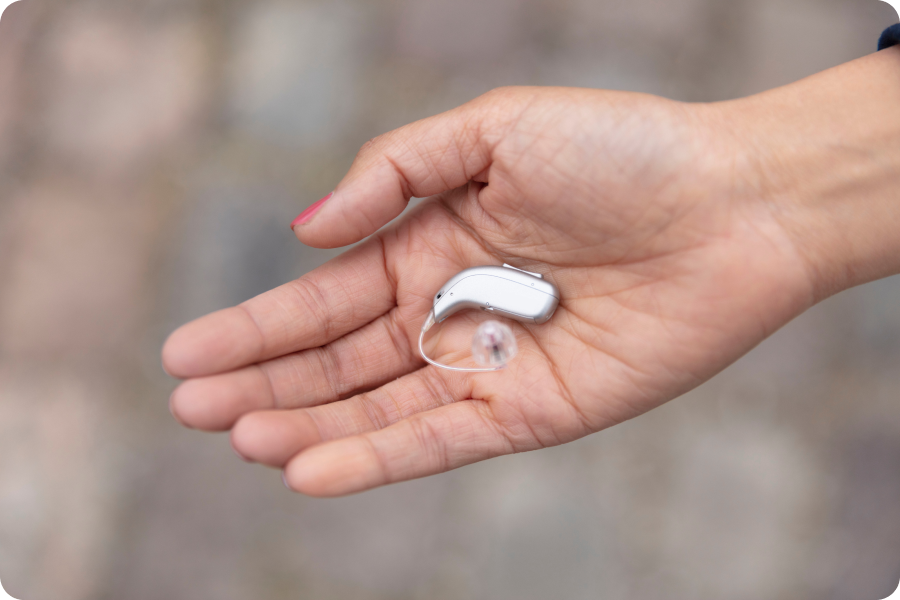
Mini behind-the-ear hearing aids (RIC): a discreet, high-performance solution
Key features:
- Almost invisible : designed to fit seamlessly into the ear canal, they offer a discreet solution that’s perfectly adapted to the ear’s anatomy.
- Miniature case : placed behind the ear to remain almost undetectable.
- Transparent wire or tube : connected to the earmold, it’s thin and almost invisible.
- Easy maintenance : equipped with replaceable wax filters for simple maintenance.
- Auditory adaptability : suitable for hearing losses ranging from mild to severe, with enhanced performance in a variety of environments.
- Customization : available in a range of sizes and styles to suit everyone’s aesthetic preferences and comfort.

Important notice : an assessment by an audioprosthetist is required to determine which model is right for you.
How to choose hearing aids? Which ones are best suited to your hearing: in-the-ear, full shell or half shell?
Key features:
- Custom-made : although more noticeable, they remain discreet and aesthetically pleasing thanks to a precise molding of your ear.
- Fit in the auricle concha : placed in the auricle, they are well-positioned for optimum comfort.
- Suitable for moderate to moderately severe hearing losses : they adapt to a wide range of hearing losses.
- Ideal for people with dexterity difficulties : thanks to their larger format, they offer simplified handling and easy-to-adjust settings for everyday use.
- Improved sound quality : thanks to their position, they provide optimum amplification of sounds, especially the lower frequencies.
- Easy maintenance and battery management : larger models are equipped with easily accessible battery compartments that are simple to replace.
- Availability of rechargeable technology : for added convenience, they are now available in a rechargeable version. No need to change batteries!
- Optimal stability and fit : their design allows them to better hold in place, especially for users with uniquely shaped ear canals.
- Compatibility with accessories: They can be used with a wide range of wireless accessories and a remote control. In addition, they are often compatible with Bluetooth technology.

Important notice : an assessment by an audioprosthetist is required to determine which model is right for you.
Why choose classic behind-the-ear hearing aids?
Key features:
- Uncompromising power : although they are more noticeable due to their design, these hearing aids are intended to offer optimum comfort thanks to their light weight and customized fit. Thanks to their amplification power and technology, these prostheses are suitable for a very wide range of hearing losses, from mild to severe.
- Consisting of a part behind the ear (case) and a part inside the ear (earmold): the part behind the ear contains the main electronic components (amplifier, microprocessor, microphone). It is connected to an earmold made from a molding of your ear, inserted into the ear canal.
- Require custom-fit ear tips: The ear tips are custom-made to perfectly match the shape of your ear, ensuring a secure fit, enhanced comfort, and superior sound quality.
- Ergonomic for people with dexterity difficulties : their slightly larger size makes them easier to handle, clean and maintain, which is ideal for people with fine motor skills issues.
- Rechargeable batteries : for added convenience, classic behind-the-ear hearing aids are now available in a rechargeable format. Say goodbye to battery replacements!
Important notice : an assessment by an audioprosthetist is required to determine which model is right for you.